Tuesday, February 18, 2014

Namenekovegi and Sushitenmaru Teach Origami, Celebrate Valentine's Day


Origami Valentines
Lending a hand
Just before they packed their bags and headed to Brooklyn, our Japanese friends taught us how to make Secret Friend's Knots; at one time, valentines were folded in this way, so private messages could be sent between friends. We also tried our hands at making heart-shaped valentines, little jumping frogs, and other animals. Some of us were really good at it! We found it to be very relaxing, even though we really needed to concentrate on what we were doing. 

After learning some origami techniques, we celebrated with a Valentine's Day party. We listened to love songs on Pandora, exchanged cards and candy, and had a buffet table full of treats to share. This was a special party for us, because it's our very last holiday party as a student. Next year, we will leave our elementary school to attend the middle school, where holidays aren't celebrated with parties. It's part of growing up here.

Would you like a cupcake?
Our Valentine cards

We're glad Namenekovegi and Sushitenmaru were here to share the love!

Friday, February 14, 2014

Mr. Apple in Tokyo

Mr. Apple went to Tokyo with me.
 
Tokyo Station
 
 
 Subways


in Ginza


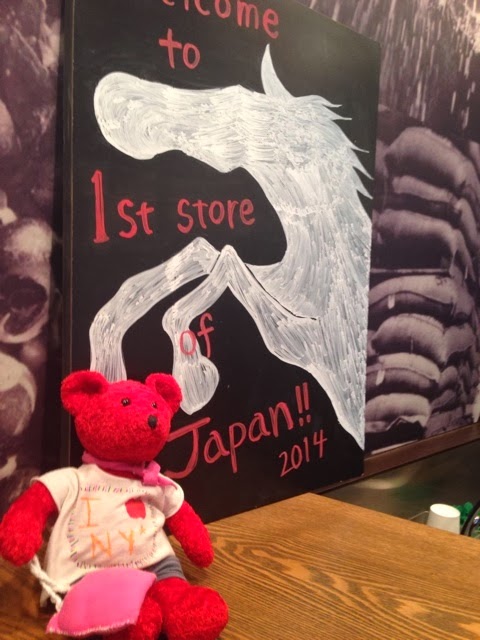
 at a coffe shop


at the front of Kabuki-za ( Japanese opera house)


Happy Valentine's Day from Japan

Happy Valentine's Day from Japan!
It snowed heavily on Valentine's day in Kanagawa.
We made Kamakura(a traditional snow house) for Mr. Apple.


At the beginning of February, we had a bean throwing day (Setsubun).
Setsubun literally means "division of seasons." It is used to mark the end of winter and summer, and is derived from the old lunar calendar. However, "setsubun" has now come to mean the day before the first day of spring only. It usually occurs around February 3rd. On this day, in a custom called mame-maki, people throw and scatter roasted soy beans inside and outside their houses while saying, "Get goblins out of the house! Invite happiness into the home!"
 
 
After throwing the beans, people customarily eat one roasted soy bean, mame, for each year of their age, and pray for happiness throughout the year.


We also have a farewell party for Mr. Apple on another day!
 
Pop-corn!


See you, Mr. Apple!
 

Friday, February 7, 2014

Chamallow in Templo Mayor

El fin de semana pasado, Chamallow visitó el Templo Mayor, en el corazón de la ciudad de México. Fue el principal templo de los Mexicas (que anteriormente eran los Aztecas) y se encontraba en un área conocida como el recinto sagrado. En 1978 la compañía de luz descubrió en una de sus excavaciones un monolito que representa a la Diosa Azteca de la luna, Coyolxauhqui. Después del descubrimiento se siguió excavando hasta descubrir el Templo Mayor, al lado del cual se levantó un museo.

En su época de esplendor el Templo Mayor era un basamento piramidal con dos templos en la cima dedicados a Huitzilopochtli, Dios de la Guerra, y a Tlaloc, Dios de la lluvia. El templo fue construido siete veces, uno encima del otro, haciéndolo cada vez más grande, su máxima altura fue de 60 metros. Lo que se puede ver en el sitio arqueológico son secciones de las diferentes etapas de construcción y algunos restos de la etapa final del templo, que fue construida alrededor del año 1500.

El Templo y sus alrededores, el recinto sagrado, fueron el centro religioso de los Mexicas. Los acontecimientos más importantes de la vida política, religiosa y económica Mexica sucedieron en esta área.

Chamallow y nuestras amigas, Abril, Mónica y Vanessa prepararon un pequeño video donde les muestran algunas de las piezas más interesantes e importantes del museo del Templo Mayor.


Last weekend Chamallow visited the Templo Mayor. The Templo Mayor stands in the heart of Mexico City. This was the main temple of the Mexica people (Aztecs) and stood within an enclosed area known as the sacred precinct. In 1978 electric company workers uncovered a monolith depicting Coyolxauqui, the Aztec moon goddess. Following this discovery, the Mexico City government gave permission for a full city block to be torn down and excavated, resulting in the Templo Mayor archaeological site and museum.

At its time of splendor, the Templo Mayor was a pyramid with two temples at the top dedicated to Huitzilopochtli, the god of war, and Tlaloc, the rain god. The temple went through seven different construction stages, with successive layers making the temple larger, until it reached its maximum height of about 200 feet (60 m). What remains visible to visitors today are sections of the temple's different construction phases. Little remains of the final layer of the temple which was built around 1500.


The Temple and the area around it, known as the temple precinct, were the center of Mexica religious life in Tenochtitlan. The most important aspects of Mexica political, religious and economic life took place within this area.

Chamallow and our friends Abril, Mónica and Vanessa prepared a brief video showing you some of the most important and most interesting pieces in the Templo Mayor museum.


Crêpes con Chamallow

En México acostumbramos celebrar el Día de la Candelaria (2 de febrero) comiendo tamales de diferentes ingredientes y sabores, dulces y picantes. Chamallow disfrutó sus tamales acompañados con atole champurrado de chocolate. Sin embargo, sabemos que en Francia, la tierra de Chamallow y Tagada, el Día de la Candelaria es la fiesta de las Crêpes. 

El año pasado, nuestros amigos de Montpellier nos enviaron un video mostrándonos cómo prepararlas. Así que este Día de la Candelaria pusimos manos a la obra y nos unimos a la fiesta de las Crêpes, que por cierto, ¡Quedaron deliciosas!

¡Muchas gracias por compartinos la receta!


In Mexico we celebrate Candlemas (February 2nd) eating tamales prepared with different ingredients, sweet and spicy. Chamallow enjoyed his tamales with chocolate atole. On the other hand, we know in France, Chamallow and Tagada's homeland, Candlemas is The Day of the Crêpes.

Last year our friends from Montpellier sent us a video showing us how to prepare crêpes. So last weekend we became chefs and joined the French party. Crêpes were delicious!

Thank you, French Friends!


Tuesday, February 4, 2014

"La Chandeleur", la fiesta de las crêpes con Bucky

El 2 de febrero fue el día de "la chandeleur" o de la Candelaria. En Francia es costumbre hacer crêpes.
Las crêpes son originarias del noroeste de Francia, de la región de Bretaña.
Las crêpes están hechas con harina, huevos y leche. Se acompañan de mermelada, chocolate caliente o azúcar. También hay crêpes saladas.
Bucky pasó este día en casa de Myriam Ouzouline y participó en la preparación de las crêpes.
Creemos que le encantaron.

In France, crêpes are traditionally served on Candlemas (La Chandeleur), February 2. This day was originally Virgin Mary's Blessing Day, but became known in France as "Le Jour des Crêpes" (literally translated "The Day of the Crêpes"). A crêpe or crepe  is a type of very thin pancake, usually made from wheat flour (crêpes de Froment) or buckwheat flour (galettes). Crêpes are often associated with Brittany, a region in the northwest of France. They may then be rolled or folded, and filled with different ingredients. Depending on the filling ingredients, filled crêpes can be either a dessert dish or a main course.

Bucky was in Miryam's home.